12.04.2012
Cathy Ashley, Family Rights Group chief executive’s response to rise in care applications
Ms Ashley said: "The care system is really struggling to cope with the rising numbers of care order applications. There are court delays, children being put in temporary placements or moved around with little notice, siblings are being split up and there are a significant shortage of foster carers.
“Family Rights Group knows from the rising calls to our advice service and recent research that in some of these cases more could and should be done to have kept children safely with their family. The closure of key early intervention and preventative services, such as refuge places for abused mothers, is worsening this terrible situation.
“Not enough is being done early on (eg through a family group conference) to identify and assist wider family members such as older siblings and grandparents to take on the raising of children unable to live with their parents, which is shocking.
“Our recent survey of family and friends carers found 20% of the children have been in unrelated care before living with their kinship carer - in numerous cases this could have been avoided - which would be in the interests of both the children and public purse."
27.03.2012
Local authorities leave family and friends carers to fend for themselves
Family and friends carers, who are raising some of the nation’s most vulnerable children, are being left to fend for themselves and suffer significant levels of hardship as local authorities fail to implement central government policy, according to major new research from advice charity Family Rights Group.
When children are unable to live with either of their parents, official guidance stipulates they should be enabled to live with a member of their extended family or social network, provided this is feasible and in the child’s best interests. Yet one of the largest series of studies to date, by Family Rights Group, in partnership with Oxford University’s Centre for Family Law and Policy, has uncovered a major lack of support for family and friends carers or ‘kinship carers’ and the estimated 250,000 children living with them.
The studies, which include: a survey of more than 490 carers raising more than 750 children; 95 in-depth interviews; an analysis of government data and a Freedom of Information request to local authorities, show:
• One in five children (20%) being cared for by a friend or family member had first been placed in unrelated foster care before eventually being moved to a kinship arrangement, creating twice the upheaval and placing unnecessary burdens on an already stretched care system
• Forty-five per cent of English local authorities had not published a family and friends care policy, more than five months after the government required them to do so [1]
• Almost half of carers (44%) surveyed said they had received no practical help from their local authority and 95 per cent identified at least one form of support they had needed, but not received - most mentioned several. The great majority – more than 70 per cent - rated the support they had received from their local authority as poor or very poor
• Seventy-six per cent of carers surveyed felt they did not have enough understanding of the legal options and the implications for the level of support they would receive to make informed decisions [2]
• Interviews with carers show that more than a third (38%) of children living with family and friends carers suffer emotional and behavioural problems and many have learning and physical disabilities
• Carers bringing up those children face significant challenges, with almost two-thirds having raised stress levels - twice the national average - and 38 per cent exhibiting high levels of stress
Family Rights Group advises families whose children are involved with or need children’s services because of welfare needs or concerns. Its chief executive, Cathy Ashley, said: “Family and friends carers gain a lot of love and satisfaction from their role but it often has significant personal, mental and financial costs, which are exacerbated by the lack of support from local authorities.
“We know that the system simply cannot cope with the increasing numbers of children going into care – there’s a shortage of foster carers and there are huge delays in the court system. Consequently many children end up going through multiple moves, which can have a devastating impact on their lives.
“Our research shows many local authorities are not fully exploring and supporting opportunities to place children with family and friends, who can offer the security, continuity and love they so desperately need. These people are relieving a great deal of pressure from the state care system and acting in the best interests of incredibly vulnerable children, benefiting the rest of society. They deserve better. The amount and type of support carers receive from local authorities appears to bear little or no relationship to the child’s or carer’s needs, which is absolutely shocking.
“Councils’ failure to help and support people through the legal minefield when they are raising children that would otherwise be the authority’s responsibility is a dereliction of duty. The consequence is that carers, and, by direct implication, the children, are denied the legal, financial and practical support they are rightly entitled to.”
Irene's story
Paternal grandmother Irene and her husband look after their seven-year-old granddaughter ‘B’ and ‘B’’s half-sister, ‘A’, aged nine, who Irene refers to as her ‘gift of a granddaughter’.
She says she has been through hell and back with Cambridgeshire Social Services in a two-and-a-half year battle to gain a Special Guardianship Order, which was granted in January 2007.
The mum’s partner is believed to have caused non-accidental injuries to ‘A’ in April 2003, when she was four months old, and she was placed into foster care until her mother became pregnant with ‘B’ in 2004, at which point ‘A’ went back to live with her. Both girls were then subsequently removed from their mum in April 2005, which was when Irene and her husband decided to take on the children, even though only ‘B’ was a blood relative of theirs.
Irene said: “My involvement with social services was very upsetting and dispiriting. They backtracked on what they said and wanted to remove ‘A’ from us. They threatened to take my granddaughter if we did not let her go but I said no, they’re staying together.
“The council made me give up work as a nurse. They told me if I didn’t the children would not be placed with me. That was my career gone but the children’s needs came first. I sacrificed a lot but we felt that’s what we needed to do.
“This experience was very stressful. I served in the air force, and I’m a very strong character but they turned me into someone who easily broke down in tears because of the stress. I couldn’t sleep. I was afraid to open the door - we just did not know what social services were going to say or do next.”
Cathy Ashley added: “There has been a lot of talk from the Government recently about adoption but very little focus on alternatives for children who cannot live with their parents. We hope this report will highlight the incredibly important role family and friends carers are playing in providing permanent care for some of the country’s most vulnerable children.
“While the recent Government statutory guidance has helped to raise the issue of support for family and friends carers, there is considerable room for improvement. We want to see local authorities being audited and properly funded to ensure that guidance is being effectively implemented across the country. At present, that clearly isn’t happening.
“In the longer term, legislation is required to establish and fund a support framework and a national financial allowance for family and friends carers.
“The Government must also rethink changes to legal aid, which are going through the House of Lords today, which could further disadvantage carers resulting in a nonsensical situation where some family members cannot afford to obtain a permanent secure legal order for a child, who could otherwise end up in state care, at a significantly greater cost to the exchequer.”
Notes for editors
For further information, to arrange interviews with Cathy Ashley, Irene or other family and friends carers, please contact Ben Miller at Amazon PR on 020 7700 6952 or email This e-mail address is being protected from spambots. You need JavaScript enabled to view it
[1] The government published ‘Family and Friends Care: Statutory Guidance for Local Authorities’, in March 2011, requiring every local authority to publish and publicise a policy on its approach to promoting and supporting the needs of children living with family and friends carers by the end of September 2011. Family Rights Group, on behalf of the Kinship Care Alliance, sent a Freedom of Information request in October 2011 to the director of Children’s Services in every local authority in England, requesting a copy of their Family and Friends Care policy and asking them how the policy had been developed.
[2] The children may be looked after under various legal arrangements:
- An informal arrangement with the parents’ agreement
- A court order obtained by the carer (a Residence Order or Special Guardianship Order), giving the carer parental responsibility for the child. The local authority has the discretion to pay an allowance to the carer
- The child is looked after by the local authority and placed with the friend or relative who has been approved as a foster carer for the child. The carer does not have parental responsibility, which is either solely with the parents (if the child is in their care with their agreement) or the local authority also has parental responsibility if there is a care order for the child. The carer is entitled to receive a fostering allowance from the local authority.
1. Family Rights Group advises families whose children are involved with or need children’s services because of welfare needs or concerns. They promote policies and practices, including family group conferences, that help children to be raised safely and securely within their families, and campaign for effective support to assist family and friends carers, including grandparents who are raising children that cannot live at home.
2. Family Rights Group’s telephone and digital advice service helps families when social workers are involved with their children and has pioneered independent professional advocacy services for families involved with Children’s Services. They support practitioners through providing expert training and consultancy.
3.The research is made up of four parts:
i. Hunt J and Waterhouse S (2012) Understanding family and friends care: the relationship between need, support and legal status (FRG/Oxford University Centre for Family Law and Policy). In depth interviews with 95 carer households
ii. Aziz R and Roth D (2012) Understanding family and friends care: analysis of the social and economic circumstances of family and friends carers (FRG). Analysis of Government’s “Understanding Society” carers survey of 77 kinship care children living in 68 households, contrasting them with other families from the same study
iii. Ashley C (Ed) Authors: Aziz R, Roth D and Lindley B (2012) Understanding family and friends care: The largest UK survey (FRG). Understanding family and friends care: The largest UK survey (FRG). Survey of 493 carers raising 762 kinship children
iv. Ashley C (Ed) Authors: Roth D, Aziz R and Lindley B (2012) Understanding family and friends care: local authority policies – the good, the bad and the non existent (FRG) based on a Freedom of Information questionnaire sent in October 2011.
4. The research reports were made possible thanks to the generous support of the Big Lottery Fund and other key funders including Tudor Trust, Trust for London, Family Justice Council, Noel Buxton Trust. Thanks also goes to Grandparents Plus with whom we jointly conducted the Understanding family and friends care: local authority policies report and our partners in the Kinship Care Alliance.
06.03.2012
Cathy Ashley, Family Rights Group Chief Executive, has spoken out against government plans to draw up score cards for the speed with which local authorities are placing children for adoption
Ms Ashley said: “I am deeply concerned that we are moving to a system where speed of adoption matters much more than determining what is in the child's best interest when they can’t live with their parents and that fundamentally lies in finding the best and most appropriate home for them to permanently live.
“We are also really worried that adoption score cards will lead to poor decisions, leading to higher adoption breakdowns and more siblings in care being split-up from each other, which can be absolutely heartbreaking for the children involved. We’re already seeing that happening, with some adopters refusing the child in care any contact with their younger brother or sister.
“What we find particularly lacking in the government’s announcement is any commitment to proven, viable alternatives to adoption for these children, including having them raised by their wider relatives.
“Evidence shows that many children raised by a grandparent, aunt, uncle or sibling end up in a loving, caring and stable home, providing the best outcome for that child, local authorities, the government and society.”
06.03.2012
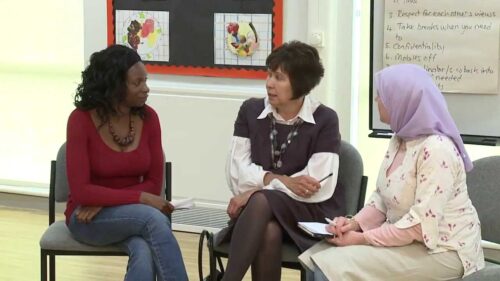
New film helps families and professionals deal with child protection conferences
A new website film to help parents and families going to child protection conferences has been released by advice charity Family Rights Group.
The film, available online from today, re-constructs a child protection conference explaining what it is all about, demystifying the process and the possible outcomes.
Marsha Rainford-May, acting service manager in the NorthWest child protection team for Westminster City Council, who appeared as an Independent Chairperson in the film, said: “The messages in this film are important in assisting families to be better prepared for what is a very difficult situation. It will also help promote good and reflective practice amongst social workers and other professionals and give them a better appreciation of what families go through. Sometimes we can forget what it’s like and the level of emotion involved.”
Cathy Ashley, Family Rights Group chief executive, said: “Child protection conferences are a statutory intervention in a family’s life and often parents’ reaction is to feel daunted, angry and very scared that their child will be taken away.
“Explaining the process visually will improve families’ ability to participate effectively in a child protection conference and give them greater ownership of the child protection plan.”
Family Rights Group identified a clear need for the video as more than one in four calls to its helpline are about child protection. Explaining what happens in a conference over the phone can be a complex task for advisers as they clarify the difficult process families face.
Ms Ashley, said: “Film is the easiest and clearest way to explain and demystify a child protection conference. Written information, which aims to do the same thing, is inevitably long and complex. Many of the target audience for the film may have language, literacy or learning difficulties.
“Research shows that getting families and professionals to work in partnership is key to enabling children to remain safely within their family home. This has clear benefits for the family, local authorities, the government and the rest of society.”
The practitioners’ roles are played by working professionals, creating a more realistic film.
Social worker Janet Phillip-Sargeant, from Waltham Forest Children’s Services, who also appears in the film, said: “This is good for parents, families and professionals as it prepares them well for the child protection conference setting and what they can expect - it will be a great help.”
About the film
The film is in two parts – before the conference and during and after the conference, plus there are filmed interviews with 4 professionals – enabling parents to dip in and out of the information.
Using professionals in role, and actors as parents the film is realistic and engaging. It will help both parents and practitioners prepare for, and participate in, these important meetings.
The film features Anne and Terry, who have been together for 18 months. Anne has a son, Jack, aged four from a previous relationship and the couple have a two-month old daughter, Layla.
The midwife was concerned about Anne’s alcohol use towards the end of the pregnancy with Layla. There were two incidents of domestic violence where the police were called and the family was subsequently referred to Children’s Services. They decided that, given Anne’s history and the apparent escalation of her alcohol use and the recent domestic violence, an initial child protection conference should be convened.
The film shows key participants at the conference including a social worker, deputy headteacher, health visitor, drug and alcohol worker, personal adviser and a police officer.
Mr Davis said: “We would normally liaise closely with the social worker but this scenario was believable and I found it easy to engage with the script.”
Notes for editors
For further information, to arrange interviews with Cathy Ashley or any of the participants in the video contact Ben Miller at Amazon PR on 020 7700 6952 or email This e-mail address is being protected from spambots. You need JavaScript enabled to view it .
Ms Ashley said: “The system can not cope with these numbers of children going into care. It’s been well reported that there’s a shortage of foster carers and there are huge delays in the court system, consequently many children end up going through multiple moves, which can have a devastating impact on their lives. “Our experience at Family Rights Group shows there are a number of effective alternatives that can have a positive impact on reducing the number of children going into care, while ensuring the child’s safety. “Firstly, Cafcass’s research highlights children are being taken away because of neglect. Providing parents, who may be struggling with their children for multiple reasons, with much greater help and support at an early stage can bring dramatic changes that prevent problems from escalating helping ensure their children remain safely with them. This was supported by the president of the Association of Director of Children’s Services. “Secondly, our work shows that local authorities are still not fully exploring and supporting alternative family and friend options such as placing the children into the care of a grandparent, aunt or uncle, older sibling or close friend who can give the child the security, continuity and love they so desperately need. Family group conferences are an extremely effective way of identifying who in the wider family could take on the care of children if they can’t live with their parents - but only a minority of families are being offered this option. “Thirdly, a lack of cooperation is a key reason why children end up in care proceedings and Family Rights Group is very effective at addressing that. Our work with families show when parents are subject to child protection enquiries by children’s services they tend to get angry, upset and are unable to hear what they’re being told by social workers and an antagonistic relationship develops. Our advice and advocacy services dramatically changes the dynamic between the two parties. Parents can have their voice heard and can hear, and therefore address, children’s services’ concerns.” “We have serious concerns about some of the issues raised in last night’s BBC 2 programme ‘Protecting Our Children’.
09.02.2012
Statement from Cathy Ashley, Chief Executive Family Rights Group in response to the record numbers of children being referred into care
31.01.2012
Statement from Cathy Ashley, Chief Executive Family Rights Group in response to BBC2 documentary, Protecting Our Children (shown last night)
“The programme failed to show the practical parental support mum and dad needed, and which should have been provided by children’s social services, for the parents to have stood a real chance of being allowed to look after their children.
“These parents had little or no parenting skills. Mum has been in care herself and dad clearly struggled with significant difficulties too.
“These parents desperately needed practical help and hands-on guidance to improve their parenting skills. “In the child protection conference itself, the parents looked lost and isolated. Our experience is that too often in such an atmosphere, scared and angry parents can’t hear what social workers have to say and thus are seen as failing to co-operate. That’s why we promote having a specialist advocate to help the parents listen and be heard.
“The film also failed to clearly explore the impact of splitting up of the siblings. At the end of the film, it was clear that although the plan for the older child was adoption, no such placement had been found. Instead he was separated from his sister and contact with his mother had ceased.
“The film provides just a snapshot of this families’ life. But the indications are, and we know from our work, that effective early help from the outset can often avoid the tragic situation of families being broken up and children ending up in care.”
22.12.2011
Statement from Cathy Ashley, Chief Executive Family Rights Group in response to the Government’s review on the assessment process for prospective adopters including formation of an expert panel
“It is not in any child’s interest for there to be unnecessary delays in the adoption process, but the system must be rigorous. We are extremely concerned that so much attention is being given by Martin Narey, the new government adoption tsar, to the needs of potential adopters rather than on the welfare of individual children and the importance of finding a placement that is right for them. Any review of adoption should reflect the needs of these vulnerable children and also their connections with their birth family, it is therefore worrying that absent from the review panel are organisations with specialist knowledge of representing children in care and their birth families.
Moreover, the current focus upon adoption is in danger of distracting attention from addressing the wider crisis affecting the rising number of children in the care system, and many more on the edge of care. For most of these children, adoption will never be a desirable or feasible option, but they do need stability, love and security. The Fostering Network this week highlighted a significant shortage of fostering carers, which means “too many children in care are having to settle for second best.. living with a foster carer a long way from the child’s family …or who does not have space for their brothers and sisters.., or even living in residential care when fostering has been identified as the right option.” Four times as many children, who cannot live with their parents, are being raised by with relatives or friends as there are in the care system. Often these impoverished family and friends carers, mainly grandparents or older siblings, receive no support from the state and are left to deal on their own with traumatised children, putting the placement at risk. It is vital that Government policy really focuses upon securing the best outcomes for all these children.”
10.11.2011
Statement from Cathy Ashley, Chief Executive Family Rights Group in response to today’s Court of Appeal Judgement re Kent County Council (versus a grandparent carer)
“The Court of Appeal today has thrown out Kent Council’s claim that they did not have responsibility to support a grandmother, who had taken on the care of her grandchild in 2005, at their request. The Council claimed it was a private family arrangement despite their substantial involvement in placing the child. This long awaited judgement is significant in confirming that local authorities across the country who ask relatives or friends to care for children who cannot remain safely with their parents, have a legal duty to provide support including financial assistance for the child.
We are getting increasing number of calls to our advice service from impoverished relatives who are struggling to bring up very vulnerable children at their local authority’s request, but are subsequently denied help. This judgement therefore has widespread implications for them, yet cash strapped local authorities will struggle to meet this duty without additional government funding. It is now incumbent on both local and central government to find ways to ensure this ruling is implemented in children’s best interests.”
Case: SA, R (on the application of) v Kent County Council [2011] EWCA Civ 1303 (10 November 2011).
03.11.2011
Family Rights Group's response to the Family Justice Review:
The Charity, responding to the Family Justice Review’s final report, welcomed many of the detailed proposals aimed at reducing court delays and improving judicial continuity. However, it expressed serious concerns that not more was being proposed to avert care proceedings and that some of the Review’s recommendations could water down the court’s ability to scrutinize key decisions in care cases, for example whether siblings should be placed together.
Cathy Ashley, Family Rights Group’s Chief Executive commented.
“There are many thoughtful proposals in this report which we welcome. We are extremely supportive of measures to introduce a single family court and specialist family judges, to expand the Family Drugs and Alcohol Court and strengthen the role of Independent Reviewing Officers. We strongly back the report’s recommendation to enable siblings to apply for contact without the need to seek the permission of the court. And we view the new Child Arrangements Order as a very constructive way of enabling parents and family members to make consensual arrangements about a child but with legal bite
“However, we are seriously concerned that the combination of a number of measures, including interim care orders being extended for up to 6 months and proposals to significantly reduce the role of the judge in scrutinizing care plans, will result in cases of very poor local authority practice going unchallenged. We regularly come across such cases, where it is the judge’s intervention that proved key in ensuring that the child’s interests were fully considered. We fear that removing such scrutiny will be to the detriment of very vulnerable children and families.
“Whilst encouraged that alternative dispute resolution, including piloting mediation in public law cases, is mentioned in the review, we think the review could have gone much further in how this could be used when children are on the edge of care. There is evidence that advice and advocacy for parents during the child protection process can help them understand and face up to serious problems when they first emerge. Most families are still not offered a family group conference prior to care proceedings. This is despite the evidence that they are often effective in averting children going into care, by enabling the child to live safely and securely within their extended family network, for example with grandparents.”
31.10.2011
In response to the Government’s announcements today on adoption, Cathy Ashley, Chief Executive of Family Rights Group commented:
“It is the responsibility of all of us, to ensure that every child is brought up in a stable, loving environment. But decisions about the future of each vulnerable child should reflect their specific needs and circumstances and must never be driven by a local authority’s wish to look good in a performance table.
League tables and targets have been discredited by the Munro Review into child protection, which showed that often they didn’t message a child or family’s actual experiences, but could be manipulated and distorted. We are deeply concerned that Government is the now proposing to revive such tables for adoption performance.
The Ofsted report last week on children on the edge of care, confirmed what we know from advising thousands of families each year about the welfare and protection of their children, that early intervention and intensive support, can prevent more children from unnecessarily entering into care. Such help is not consistently being provided now.
We are also under no misapprehension that some children cannot remain with their parents. However, we are also clear that removing a child unnecessarily away from its birth family can be devastating for the child and that considerably more could be done to safeguard children within their families. Consistently overlooked is that fact that there are four times as many children, who cannot live with their parents, being raised by with relatives or friends as there are in the care system. Often these impoverished family and friends carers, mainly grandparents, receive no support from the state and are left to deal on their own with traumatised children. We know of placements that have faltered or broken down because of lack of support from authorities, despite the pleading of relatives for help.
The most significant step any Government could take to improve the lives of children who cannot live safely with their parents, would be to introduce a proper national financial and practical support system for family and friends carers.”